A deterministic, reversible intelligence substrate
7 issued & pending patents · Verified on NVIDIA H100 · Deterministic scaling
The post‑Transformer substrate for civilization‑scale reasoning, memory, and simulation
Oikonomia Architektur is building a new computational substrate grounded in a reversible, chaos‑bounded transport primitive. The system preserves structure across time, scale, and domain—enabling stable long‑context reasoning, multi‑scale simulation, and deterministic behavior on modern GPUs. This is not a larger model. It is a different physics for computation.
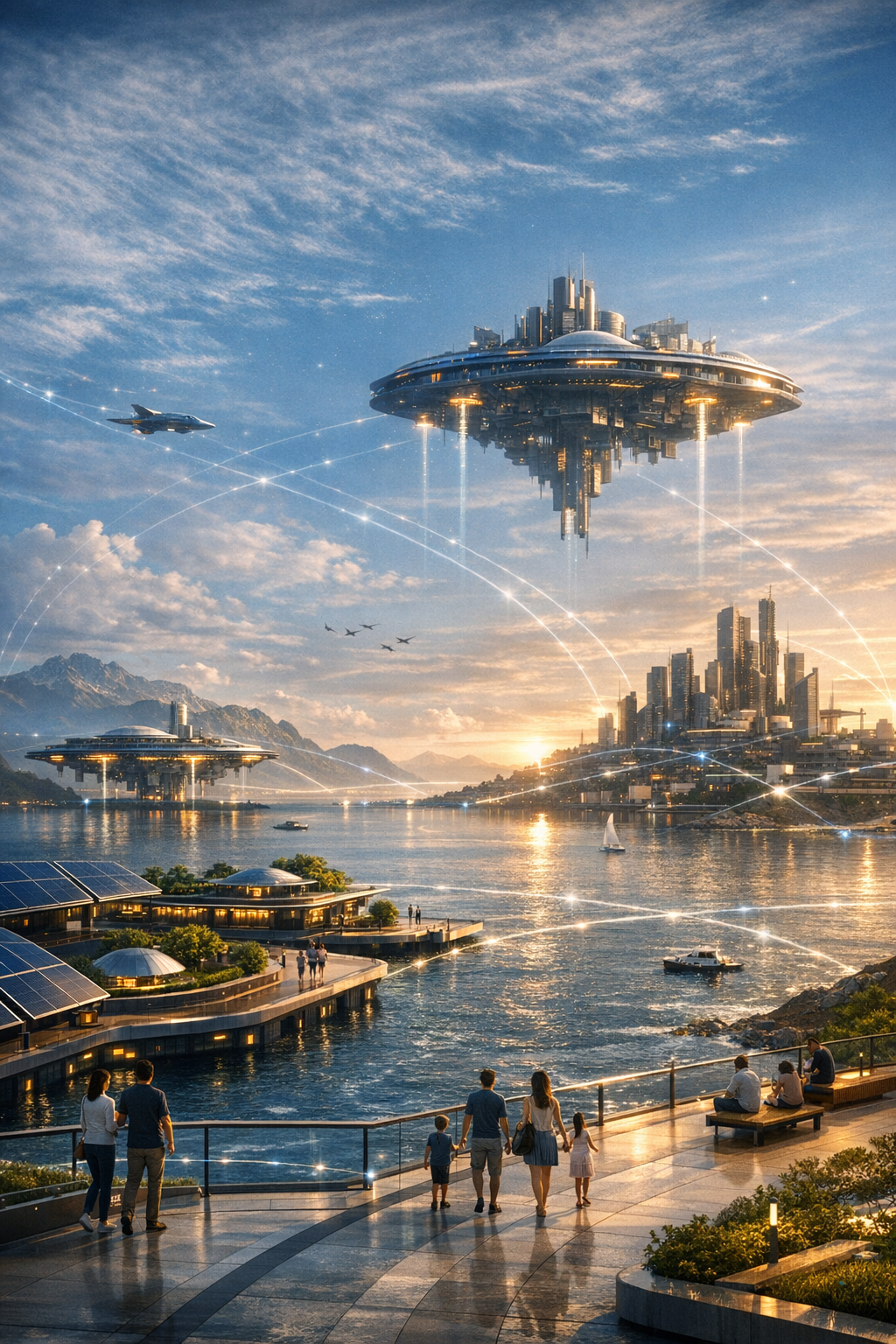
Civilization‑scale coastal systems stabilized by geometry‑native intelligence
The patented substrate
The platform is built from seven tightly coupled inventions, each protected by its own patent and unified into a single substrate:
- Deterministic General Intelligence Core (DGIC) — a reversible cognitive engine built from orthogonal transforms and bounded nonlinear perturbations.
- Reversible Inference Operator — an invertible forward/inverse primitive with machine‑precision reconstruction.
- Chaos‑Bounded Stabilization Operator — a contraction mechanism that tames chaotic dynamics without destroying nonlinear richness.
- Bounded Nonlinear Universe Simulator (DUS) — a deterministic world model with chaos‑bounded evolution.
- Deterministic Cognition‑Simulation Loop — a closed loop where reversible cognition drives a bounded universe simulator.
- Fractal Multi‑Scale Computational Architecture — a scale‑free, linear‑time operator with analytic scaling laws.
- Deterministic Chaos‑Tolerant Compute Substrate — a safety‑bounded, overflow‑safe execution fabric for chaotic workloads.
Together, these form a geometry‑native computational law designed to sit beneath AI systems, scientific codes, financial engines, and autonomous infrastructure. This is the kind of substrate that can compound into trillion‑dollar value: one primitive, licensed across every domain that cannot afford drift.
Ask Oikonomia
Run the Trillion‑Token Scaling Explorer
A public, deterministic, trillion‑token–capable streaming operator. This is the same primitive used in the Validation Suite, now available as a reproducible Docker artifact.
docker pull ji3434/scaling-explorer:latest
docker run --gpus all ji3434/scaling-explorer:latest
Deterministic · Reversible · Billion‑token verified · Trillion‑token capable
Run the GPU‑Verified Artifact (Docker)
The core substrate and validation suite are available as a reproducible container image. Run the same hardware‑verified tests shown on the Validation page:
docker pull ji3434/benchmark:latest
docker run --gpus all ji3434/benchmark:latest
Digest‑locked, deterministic, and verified on NVIDIA H100, A100, L40S, and T4.
Run the GPU‑Verified Reversible Artifact
The reversible plasma core is a digest‑locked, deterministic micro‑artifact validated on NVIDIA H100. Run the exact same forward/backward test shown on the Validation page:
docker pull ji3434/plasma-core:latest
docker run --gpus all ji3434/plasma-core:latest
Verified on H100 · Deterministic · Reversible · Cross‑hardware reproducible
Evaluate Your Workload
For systems where failure is not an option—AI infrastructure, government programs, financial engines, aerospace, energy, and scientific compute—you can evaluate how this substrate behaves on your real workload.
What you get
- Stability profile — drift, reversibility, long‑horizon behavior.
- Cost and latency comparison — baseline vs fractal streaming.
- Scaling forecast — cost vs sequence length and complexity.
- Integration outline — how the substrate fits under your stack.
How it works
- Step 1 — You share a representative workload privately.
- Step 2 — We run it on the reversible substrate in isolation.
- Step 3 — You receive a concise report with metrics and plots.
- Step 4 — If aligned, we define a path to pilot or embed.
Built for high‑stakes systems — AI labs, national programs, financial engines, scientific compute groups, robotics and aerospace teams, and mission‑critical operators.
→ Begin a private workload evaluation
Why this substrate
Modern systems collapse as context length and complexity grow: latency spikes, costs rise, and behavior becomes unstable. The fractal streaming operator maintains structure over long horizons while keeping cost effectively linear.
Scaling is not an afterthought—it is a first‑class object. Operations, time, and cost can be reasoned about analytically before deployment.
Built for real‑world systems
Whether you run long‑horizon simulations, multi‑agent planning, risk engines, or large‑context retrieval, the substrate integrates cleanly into high‑performance compute stacks. The same primitive that powers the Validation Suite and Scaling Explorer can sit beneath AI systems, scientific codes, or financial models.
Deterministic scaling
The analytic model forecasts cost and latency across sequence lengths. You can see when naive baselines fail—and when the fractal path remains stable.
Cross‑domain invariance
The operator preserves structure across semantic, geometric, and physical domains—evidence of a true computational substrate rather than a task‑specific algorithm.
Founder‑led invention
Oikonomia Architektur is led by Joseph William Iko, the sole inventor of the reversible primitives powering the substrate and the architect of the seven‑patent stack.
Why This Matters
Modern AI scales by brute force. It memorizes, approximates, and collapses under long‑horizon reasoning. Oikonomia takes a different path: a reversible, geometry‑native substrate where information is never lost, transport is deterministic, and cost scales predictably.
Civilization runs on systems that must not drift: energy grids, supply chains, climate models, medicine, aerospace, multi‑agent coordination. These systems fail when computation becomes unstable or opaque.
A reversible substrate with long‑horizon memory changes the equation. It enables computation that is traceable, stable, and indefinitely extensible—the foundation for intelligence that can operate at planetary scale without collapse.
What This Enables
Oikonomia is not a model. It is a substrate that can host reasoning, simulation, and control across domains without retraining or architectural redesign.
- City‑scale coordination — traffic, energy, logistics, emergency response.
- Climate and planetary simulation — stable long‑horizon modeling without drift.
- Medicine and biological systems — reversible inference for safety‑critical decisions.
- Autonomous infrastructure — drones, robotics, multi‑agent systems with deterministic behavior.
- Aerospace and flight systems — control loops that remain stable under extreme conditions.
- Digital settlements and economic systems — coherent, simulation‑aligned governance.
These are not “use cases.” They are domains of civilization. A substrate that scales across all of them is not a product—it is infrastructure.
Oikonomia is a new computational primitive: a reversible, geometry‑native substrate for civilization‑scale intelligence.
Platform Vision
The future of intelligence will not be built from larger models or deeper stacks of approximations. It will be built from stable computation—systems that preserve structure, maintain memory, and behave predictably as scale increases.
The vision is simple: a single reversible primitive that can host reasoning, simulation, and control across every domain of civilization. From energy grids to climate systems, from medicine to aerospace, from multi‑agent coordination to planetary simulation, the same substrate provides a coherent computational foundation.
This is not a roadmap. It is a unified computational law designed for the next century of infrastructure, research, and intelligent systems.
For Institutions
Institutions adopt technologies that are stable, interpretable, and guaranteed to behave the same way today, tomorrow, and ten years from now. Oikonomia provides deterministic scaling, long‑horizon memory, and cross‑domain invariance—properties essential for mission‑critical systems.
The architecture integrates cleanly into existing HPC environments. Universities, research labs, aerospace groups, energy operators, and financial institutions can embed the substrate beneath their models, simulations, and control systems to achieve stability and scale without architectural redesign.
If your organization depends on systems that must not drift—climate models, risk engines, robotics fleets, supply chains, scientific codes—Oikonomia provides a computational foundation built for long‑term reliability.
Founder’s Note
I built this architecture because modern systems were collapsing under their own weight. Context windows grew, costs spiked, and long‑horizon reasoning became unstable. The world needed a computational substrate that could preserve structure, maintain memory, and scale without failure.
The reversible primitives at the core of Oikonomia emerged from years of independent research into geometry‑native computation, deterministic transport, chaos‑bounded dynamics, and multi‑scale memory. What began as a theoretical model is now a working, validated system running on real hardware.
My goal is simple: provide a stable computational foundation for the systems that matter— the systems that shape cities, energy, medicine, climate, aerospace, and the future of intelligent infrastructure.
— Joseph William Iko, Founder & Inventor
Flagship demo: Fractal Scaling Cost Explorer
The Fractal Scaling Cost Explorer is a thin slice of the substrate: a way to compare a naive baseline against a fractal streaming pass using an analytic model. It makes the scaling law explicit—the law that infra and research teams care about.
Open the explorer, plug in your sequence length and query count, and watch the cost collapse. This is the kind of visibility that underpins serious, large‑scale systems.