The Infrastructure of the Next Century
Ocean platforms · Sky platforms · Autonomous industrial systems
The next century of civilization will be defined by infrastructure that can sense, adapt, and operate autonomously across oceans, atmosphere, and large-scale industrial environments. These systems require real-time geometry-native computation, distributed stability, and predictable scaling—capabilities that traditional architectures cannot provide. The fractal primitive is designed for this world.
Autonomous ocean city — stabilized by geometry-native computation
Real Hardware Validation
The Water City resilience primitive is not a concept demo — it runs on real hardware. Below is a final-state snapshot captured directly from a T4 GPU simulation, showing the megacity absorbing a Category‑5 shock, stabilizing, and returning to equilibrium.
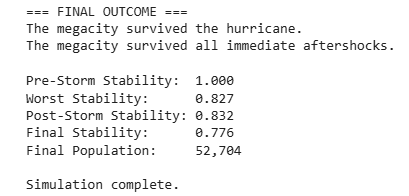
Final-state snapshot — Pre‑Storm 1.000 → Worst 0.827 → Recovery 0.832 → Final 0.776
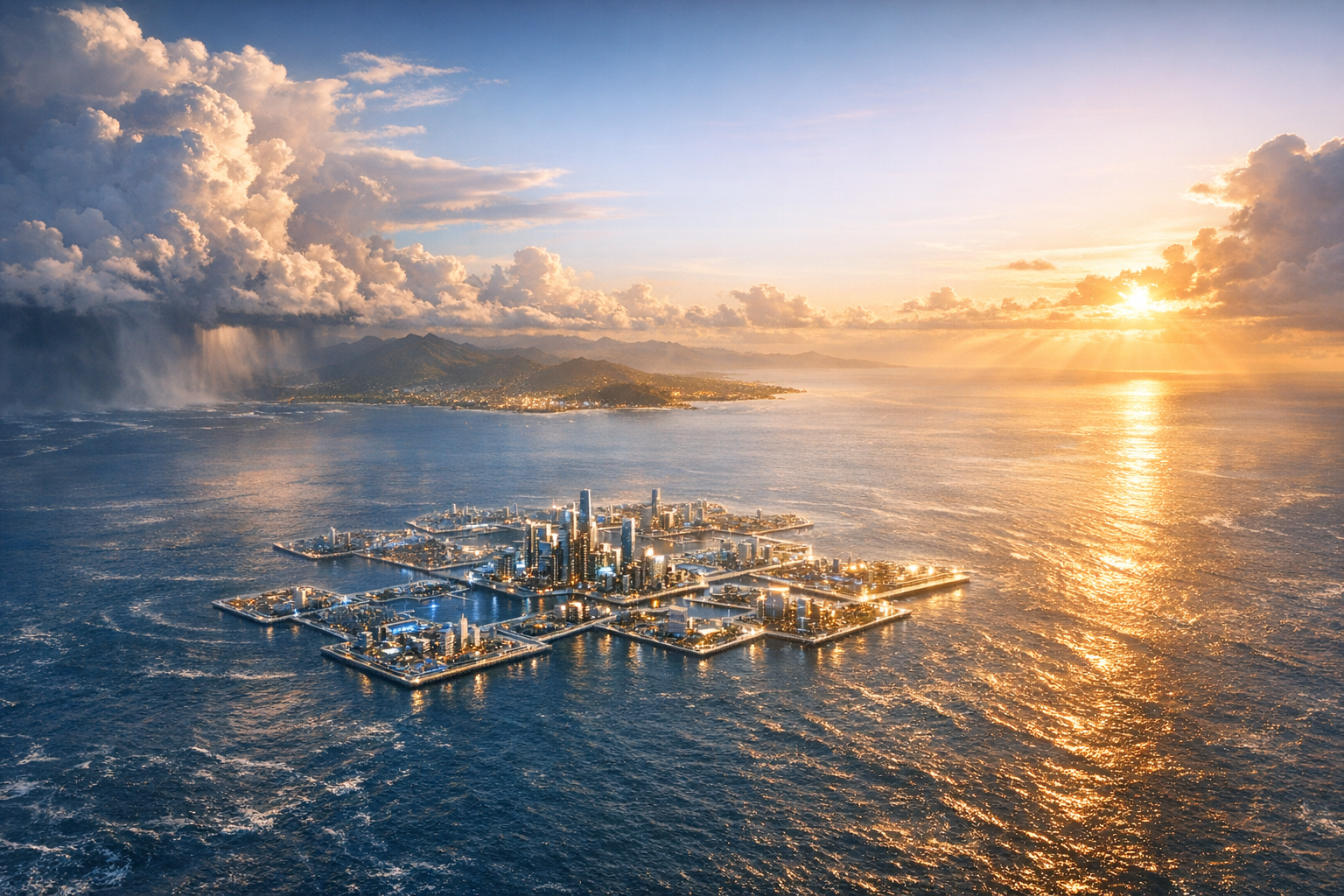
Aerial visualization — floating megacity off Puerto Rico, stabilized after a Category‑5 hurricane
Autonomous Ocean Platforms
Floating infrastructure demands continuous wave-field prediction, adaptive ballast control, and distributed sensing across large surfaces. The architecture enables stable, energy-aware intelligence for maritime systems—supporting floating industrial districts, offshore energy hubs, and climate- resilient coastal extensions. These platforms operate as self-managing environments under dynamic ocean conditions.
Atmospheric & Sky Platforms
High-altitude systems require real-time environmental modeling, dynamic geometry stabilization, and distributed inference across airborne structures. The primitive provides the control substrate for long-duration atmospheric platforms, airborne research stations, and next-generation communication infrastructure—enabling stable operation in continuously shifting atmospheric conditions.
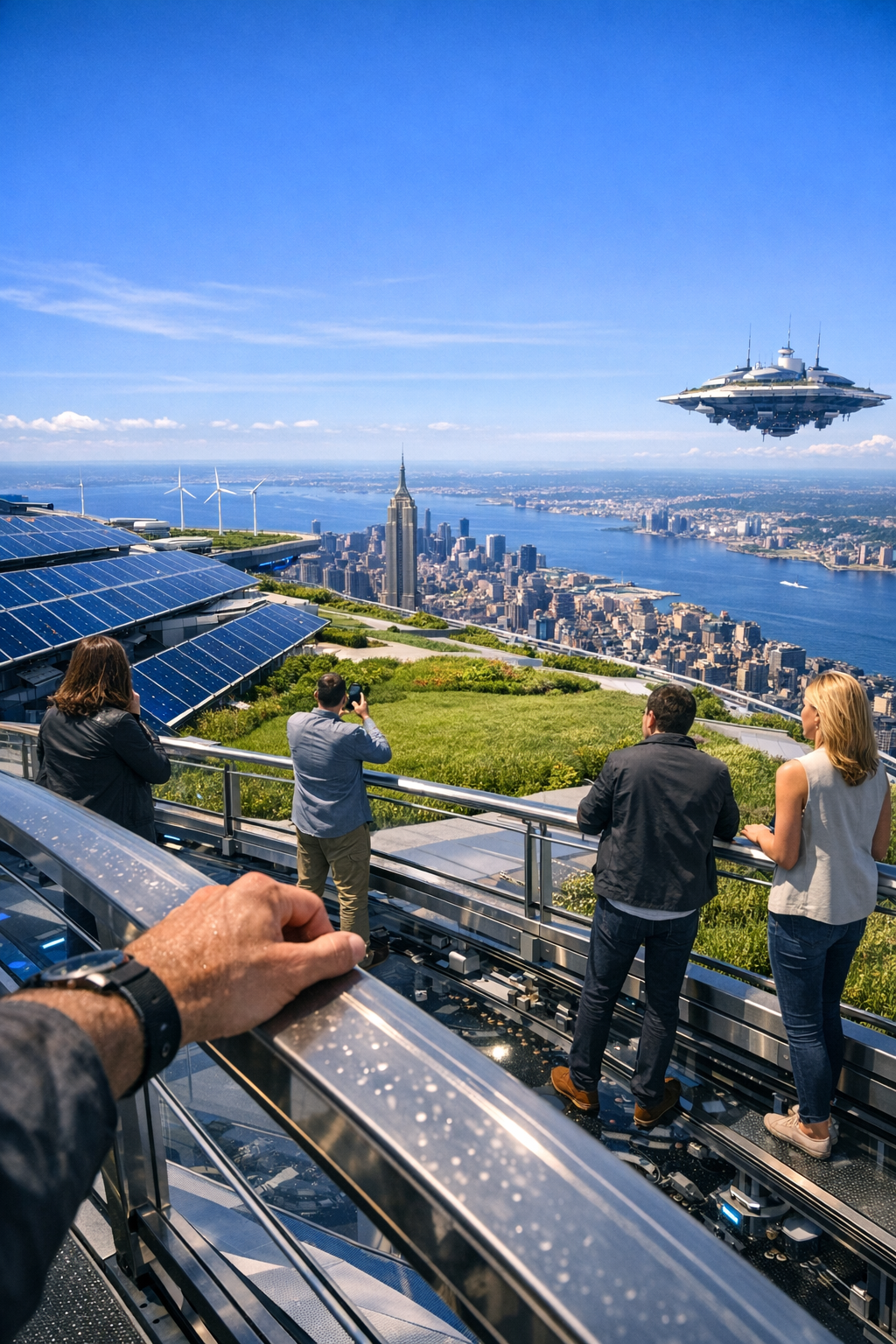
A stable clean‑energy platform operating in the upper atmosphere—geometry, intelligence, and environment in continuous equilibrium.
Industrial Megastructures
Large-scale industrial systems—ports, energy complexes, manufacturing corridors, and logistics hubs— require continuous simulation, predictive load modeling, and geometry-stable control. The architecture enables adaptive industrial environments that respond to stress, demand, and environmental conditions in real time, maintaining stability across vast physical footprints.
Energy, Climate, and Planetary Systems
Oceans and atmosphere are components of a planetary-scale system. The architecture supports high- resolution climate simulation, distributed environmental sensing, and autonomous mitigation systems. With energy-efficient inference at scale, infrastructure becomes predictive, resilient, and continuously adaptive.
A unified substrate for long-horizon infrastructure
Ocean platforms, sky platforms, and industrial megastructures share a common requirement: real-time, geometry-native intelligence that remains stable as complexity grows. The fractal architecture provides this substrate, enabling autonomous systems that operate continuously across physical scales—from local control loops to civilization-scale infrastructure.
The long-term vision is a world where infrastructure is adaptive, resilient, and self-managing: floating districts, atmospheric platforms, autonomous industrial corridors, and planetary-scale sensing systems—all coordinated through a stable computational primitive.