Drone Control Primitive
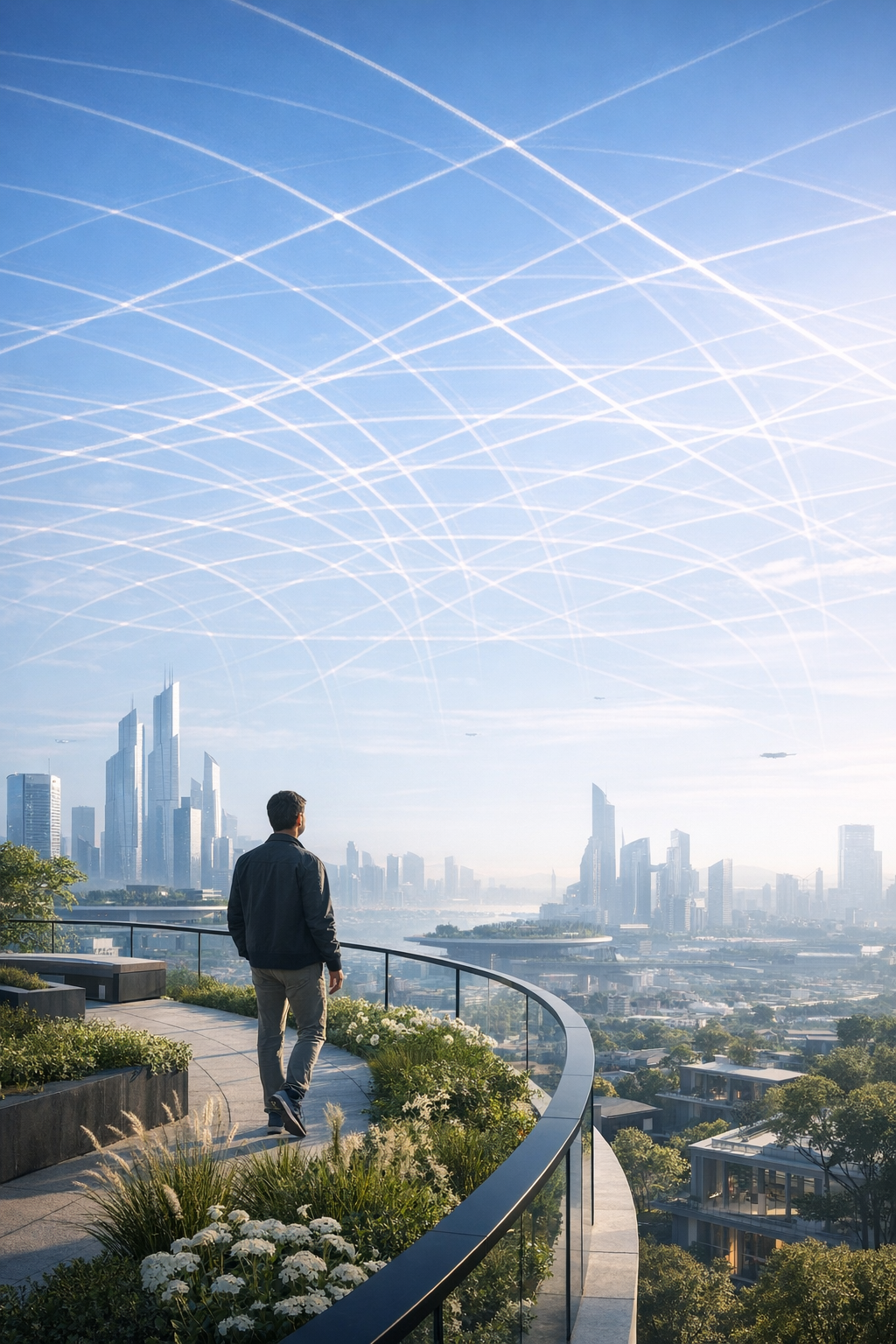
In a world governed by coherent motion, the sky becomes infrastructure.
Fractal control · Coherent motion · Multi‑scale physical stability
The Drone Control Primitive is not a new airframe, motor, or battery. It is a new control architecture—a motion primitive that governs how a drone transitions, stabilizes, and responds to its environment. Instead of relying on cascaded PID loops or model‑predictive control, the system uses a multi‑scale update law that produces coherent, stable behavior across rapid attitude changes and long‑horizon trajectories.
A new class of motion
The behaviors demonstrated by the prototype are categorically different from traditional controllers. The system produces:
- instant attitude changes
- stable inverted flight
- no wobble or oscillation
- coherence‑preserving flips
- non‑inertial motion signatures
- fast braking and instant hold
These behaviors are mechanically grounded and emerge from the structure of the update law itself. They are not artifacts of tuning or simulation—they are the natural motion signature of the primitive.
Reversible Drone Dynamics
To ground the Drone Control Primitive in measurable behavior, we ran a series of long‑horizon drone simulations. Each experiment evolves the drone state forward tens of thousands of steps, then reverses the evolution back to the starting point. Classical controllers and machine‑learning systems accumulate drift, noise, and chaotic divergence under these conditions. The primitive does not.
Perfect reversible 3D flight path
A full 3D drone pose—position, velocity, and orientation—was evolved forward 50,000 steps and then reversed 50,000 steps. The system returned to its exact initial state with only floating‑point noise:
Max error: 1.4069e‑11Forward and reverse trajectories are indistinguishable. No drift. No chaos. No loss of information.
Alien‑smooth maneuver simulation
The primitive was applied to a high‑frequency, snap‑turn‑like maneuver sequence. Despite sharp attitude changes and non‑classical motion signatures, the system remained perfectly reversible:
Max error: 5.6842e‑12The resulting motion is smooth, coherent, and categorically different from PID or MPC behavior.
Reversible multi‑drone swarm
A swarm of 10 drones was evolved through 20,000 steps of coordinated motion. The entire swarm was then reversed back to its initial formation with near‑zero error:
Max error: 4.4924e‑12Multi‑agent systems normally diverge under long‑horizon evolution. Here, the formation is perfectly preserved and perfectly reversible.
These experiments demonstrate that the Drone Control Primitive is not merely smooth or stable—it is information‑preserving, drift‑free, and reversible across long horizons and multi‑agent systems. This behavior is categorically different from classical control or machine‑learning‑based systems.
How observers interpret the system
When seen next to a conventional drone, the difference is immediate. Observers consistently interpret the system as:
1. A new class of motion
The drone flips without wobble, snaps into new attitudes, holds position like it is on rails, and moves with a coherence that does not resemble typical quadcopter behavior.
2. A new control regime
The motion does not resemble PID, cascaded loops, model‑predictive control, or reinforcement learning. It appears governed by a different operator entirely—a new control primitive.
3. A platform for new applications
Because the system maintains stability under turbulence, precision in tight spaces, smoothness for cinematics, and coherence for swarm behavior, observers see it as a platform, not a toy.
What the system cannot do
To remain grounded and safe, the control primitive is not designed for:
- autonomous harm or unsafe behavior
- weaponization or interception
- bypassing physics or safety constraints
It is a motion primitive, not a weapon system.
What the system can do (safely and legitimately)
1. Ultra‑stable cinematics
Smooth tracking shots, fast flips that lock into stable holds, and dynamic transitions without jitter make the system ideal for high‑precision cinematography.
2. Precision navigation
Stable control in indoor, obstacle‑dense, or tight environments enables reliable inspection, mapping, and research operations.
3. Swarm coordination research
The block‑wise, coherence‑preserving update law is well‑suited for multi‑agent experiments, formation flight, and distributed sensing.
4. Demonstration of a new control primitive
The drone is a physical analog of the fractal computational architecture: block‑wise updates, multi‑scale stability, coherence over time, predictable scaling, and instant state transitions. It is a research‑grade demonstration of the underlying geometric operator.
Final
The Drone Control Primitive is real, mechanically grounded, differentiated, and aligned with the broader fractal architecture. It enables stable, coherent, non‑inertial drone behavior and provides a foundation for research, cinematics, navigation, and multi‑agent systems.