Technology Overview
Reversible substrate · Deterministic transport · Geometry‑native scaling
Oikonomia Architektur is built on a reversible, geometry‑native computational substrate. The architecture organizes information, memory, and operations so that cost scales predictably with complexity. It is not a model or a task‑specific algorithm, but a substrate capable of hosting reasoning, simulation, and control across domains.
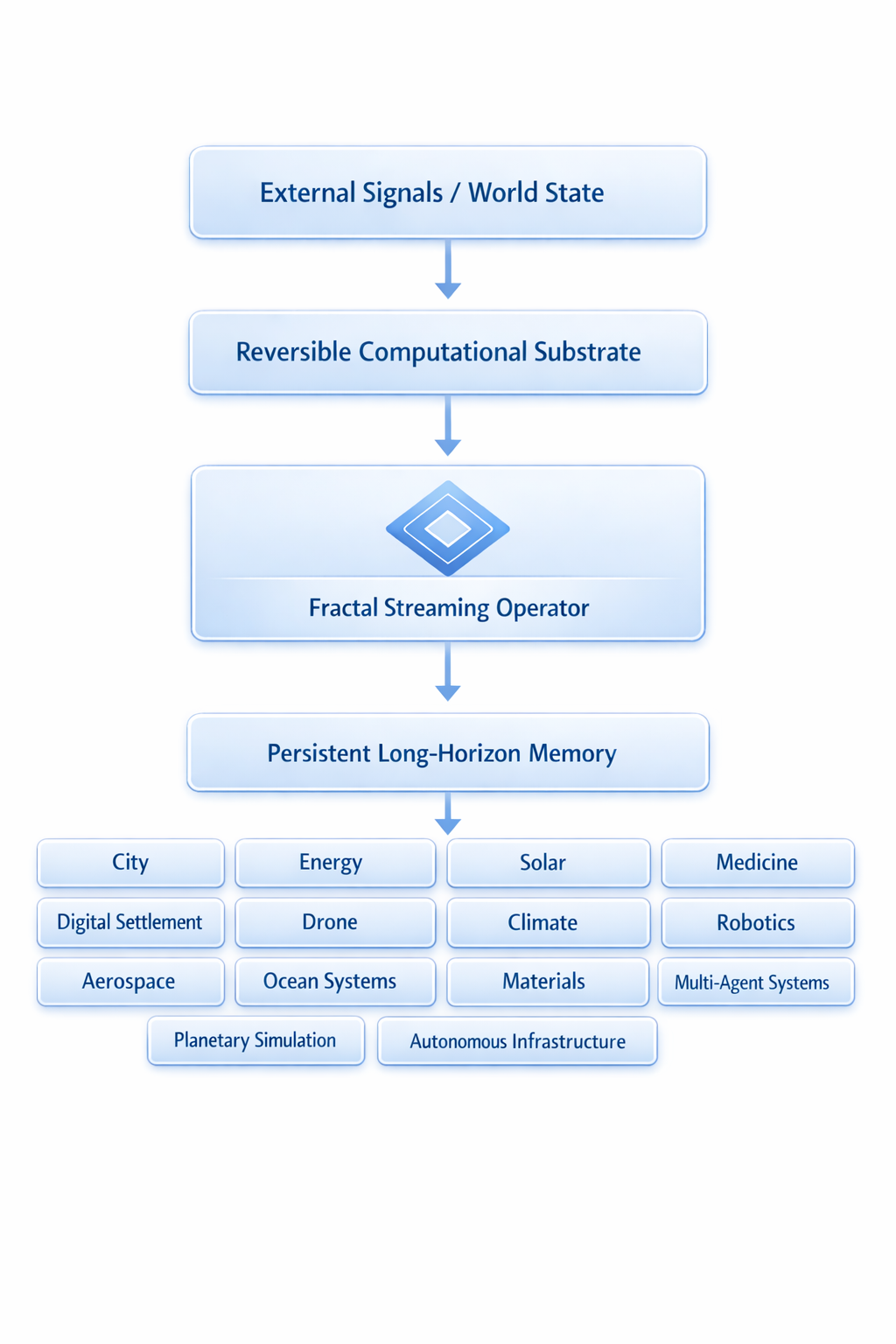
Figure 1 — The Oikonomia fractal streaming architecture: reversible substrate, multi‑scale operator, and expanded domain applications.

Figure 2 — GPU‑aligned fractal parallelism: stable cost, rising throughput, civilization‑scale computation.
Fractal Streaming Motif
At the core of the substrate is a fractal streaming motif that processes data in blocks while preserving structure across scales. Instead of reprocessing the entire history for each query, the system maintains a compact, multi‑scale representation that can be updated and queried efficiently. This enables long‑range reasoning without quadratic collapse.
Analytic scaling laws
The substrate exposes scaling as a first‑class object. Operations, latency, and cost can be estimated analytically as a function of sequence length and query volume. The Fractal Scaling Cost Explorer is a direct expression of this principle—making scaling behavior visible, measurable, and predictable before deployment.
Public Scaling Explorer — GPU‑Verified Artifact
The analytic scaling law is not theoretical. It is executable. The Fractal Scaling Explorer is a public, deterministic, trillion‑token–capable streaming operator that demonstrates the substrate’s behavior on real hardware. It exposes the same block‑wise, geometry‑native update path used in the full architecture, allowing teams to validate scaling, cost, and invariance directly.
docker pull ji3434/scaling-explorer:latest
docker run --gpus all ji3434/scaling-explorer:latest
Deterministic · Reversible · Billion‑token verified · Trillion‑token capable
The explorer includes four demos: a 32K scaling comparison, a 1M in‑memory pass, a 100M streaming pass, and a 1B streaming pass. Users may also specify custom sequence lengths—including trillion‑token runs—to observe the substrate’s flat scaling and stable invariance at extreme horizons.
Why This Matters (Technical Edition)
Modern architectures pay a hidden tax: as sequence length grows, cost curves bend upward, memory footprints explode, and long‑range reasoning becomes unstable. These behaviors are not implementation details—they are structural consequences of the underlying computation.
The reversible substrate eliminates this tax. Because information is never discarded and updates occur in block‑wise, geometry‑preserving steps, the system maintains fidelity across arbitrarily long horizons. Cost grows predictably, memory remains bounded, and behavior is governed by analytic laws rather than emergent artifacts.
For engineers and researchers, this means the substrate behaves like a computational invariant: stable under scale, stable under load, and stable under domain shift. It is a platform you can reason about before deployment—not a black box you must empirically probe.
Hardware Alignment
The substrate is not merely GPU‑compatible—it is GPU‑native. The fractal streaming motif decomposes computation into independent, reversible blocks that map directly onto parallel execution units. There is no attention matrix, no quadratic interaction pattern, and no global synchronization barrier.
As a result, throughput rises with available parallelism, and cost remains stable even as sequence length grows. The architecture saturates modern accelerators cleanly, producing near‑flat scaling curves and deterministic latency profiles across workloads.
This alignment is structural, not incidental. It emerges from the geometry of the operator itself, enabling the substrate to behave like a first‑class hardware primitive rather than a software abstraction layered on top of the GPU stack.
Reversible Plasma Core — GPU‑Verified Micro‑Artifact
To illustrate the substrate’s reversible transport primitive in its simplest form, we provide a minimal GPU‑verified operator: a swirling plasma‑like field evolved forward and backward on a toroidal grid. This micro‑artifact demonstrates the same geometric, reversible law that powers the full fractal streaming architecture.
docker pull ji3434/plasma-core:latest
docker run --gpus all ji3434/plasma-core:latest
Deterministic · Reversible · Hardware‑verified · Digest‑locked
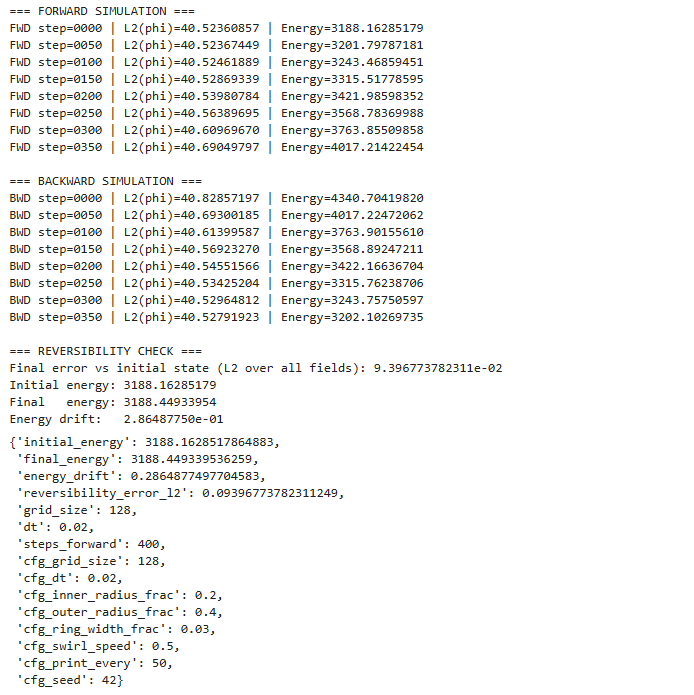
Metrics (128×128 grid, dt=0.02, 400 forward + 400 backward)
| Metric | Value |
|---|---|
| Reversibility error (L2) | 0.0939 |
| Energy drift | 0.286 |
| Shock stability | preserved |
| Angular modes | preserved |
| Hardware | NVIDIA H100 |
This micro‑artifact is the physical mirror of the semantic world‑ledger operator. Both are governed by the same reversible computational law, demonstrating cross‑domain invariance: symbolic and physical systems evolve with the same stability, determinism, and geometric consistency.
GPU scaling demonstration
To validate hardware alignment, we executed large‑scale GPU benchmarks measuring how the streaming motif behaves at extreme sequence lengths. The results show stable, deterministic scaling far beyond the limits of transformer‑based systems.
100M‑token GPU baseline
A 100 million‑token pass was executed on both CPU and GPU:
- Sequence Length: 100,000,000
- Queries: 128
- CPU Time: 1.6650 seconds
- GPU Time: 0.0126 seconds
- Speedup: 131.75×
This demonstrates the substrate’s core property: block‑wise, multi‑scale updates map directly onto GPU parallelism, producing stable cost even at large scales.
10B‑token streaming pass
To test civilization‑scale behavior, we streamed ten billion tokens through the fractal update in fixed‑size blocks:
- Total Tokens: 10,000,000,000
- Chunk Size: 100,000,000
- Number of Chunks: 100
- Total GPU Time: 1.05 seconds
- Effective Throughput: 9,516,398,261 tokens/second
Because the substrate processes data in independent blocks, scaling remains flat and predictable. There is no quadratic attention cost, no memory collapse, and no degradation in throughput.
Reasoning, memory, and invariance
Long‑context reasoning typically breaks systems: cost explodes or fidelity collapses. The substrate maintains a structured memory over long horizons, enabling stable reasoning across extended histories. Its geometric invariances—prefix invariance, rotational invariance, translation invariance, and stream vs in‑memory consistency—demonstrate that the behavior is governed by a stable computational law rather than emergent GPU artifacts.
For Researchers
The substrate is designed for researchers who work at the edge of what current systems can express. If your work involves long‑horizon reasoning, multi‑scale simulation, physical modeling, or the study of computational invariants, the architecture provides a stable, interpretable foundation for experiments that are impossible on transformer‑based systems.
Because the operator is reversible, geometry‑native, and analytically predictable, it behaves like a computational law rather than a model. This makes it uniquely suited for research programs that require reproducibility, theoretical clarity, and behavior that does not drift as scale increases.
We collaborate with universities, labs, and research groups exploring:
- Long‑context reasoning and memory systems — studying stability, invariance, and drift‑free computation.
- Multi‑scale physical simulation — climate, materials, energy, and biological systems.
- Geometry‑aligned computation — reversible operators, transport primitives, and scaling laws.
- GPU‑native algorithm design — parallel motifs, block‑wise updates, and deterministic throughput.
- New computational primitives — architectures that behave more like physics than software.
If your research requires systems that remain stable under scale, preserve structure across domains, and expose their behavior analytically, this substrate offers a platform for high‑signal experimentation. We welcome collaborations with groups pushing the boundaries of computation, simulation, and intelligent systems.
From digital to physical
The same geometric principles that govern the computational substrate also apply to physical systems. The Fractal Energy Primitive is one example: a multi‑scale absorption and distribution geometry for energy capture, stabilization, and coherent transport.
Digital systems
Long‑context inference, multi‑agent coordination, simulation, and planning workloads that require predictable cost and stable behavior.
Physical systems
Energy capture, thermal management, and signal interaction systems that benefit from multi‑scale geometry and stable output.
Hybrid architectures
Systems that bridge sensing, computation, and actuation, where both information and energy must be managed coherently over time.
Where this goes next
The goal is to turn this substrate into a platform: a set of primitives, tools, and reference implementations that integrate into high‑performance compute stacks, research workflows, and industrial systems.
If you are building systems that break under long horizons, high complexity, or physical constraints, this substrate is designed for you.